
How Much Does It Cost to Build in Ghana? The BoQ Truth (2026)
How much does it cost to build a house in Ghana in 2026? The honest answer: there is no canonical per-square-metre or per-bedroom rate — published estimates diverge three to five times over. The real cost is a Bill of Quantities (BoQ) measured by a quantity surveyor for your specific design, site, and finish. This guide explains how a BoQ is built, what drives the cost, the material prices that are genuinely published, and why we give you a measured BoQ, not a per-square-metre guess.
“How much does it cost to build a house in Ghana?” is the most-searched construction question in the country — and almost every answer online is a guess. The honest answer is that there is no canonical per-square-metre, per-bedroom, or per-square-foot rate: published estimates diverge three to five times over, and the only real cost is a Bill of Quantities measured for your specific build. This guide explains how a real cost is built, what drives it, and the material prices that are genuinely published. For your project, request a measured BoQ: +233 23 063 0030.
Why There Is No Single “Cost to Build in Ghana”
Search the question and you will find estimates from roughly GH₵1,200 per square metre to GH₵6,500-plus — a three-to-five-times spread. They disagree because:
- Every design is different — size, number of storeys, spans, and structural complexity all change the cost.
- Every finish level is different — a basic finish and an imported-luxury finish on the same shell can differ several times over.
- Every site is different — slope, access, soil, and the foundations the ground demands change the substructure cost.
- None of those blog estimates cite a survey authority — they are content-marketing ranges, not measured costs.
A single per-square-metre rate is therefore a guess, and a guessed rate is exactly the number that doubles halfway through a build. The honest answer is a measured Bill of Quantities — and that is the wedge: we give you a BoQ, not a per-square-metre guess.
How a Bill of Quantities Is Built
A Bill of Quantities (BoQ) is the measured, priced cost of your specific building, prepared by a quantity surveyor (GhIS). It is built in four steps:
- Measure (take off) — the QS measures the quantity of every item from the drawings: cubic metres of concrete, tonnes of reinforcement, number of blocks, square metres of finishes, metres of pipe and cable.
- Rate — each quantity is priced against current material and labour rates for the region (Accra, Kumasi, and Takoradi differ, and rates go stale quickly).
- Total — the priced quantities are totalled into sections — substructure, frame, roofing, finishes, services, external works — plus preliminaries.
- Control — the BoQ becomes the budget you build against, and the tool we procure and measure progress against, so cost is controlled through the project.
The result is a real number with a paper trail behind every line — the opposite of a per-square-metre guess.
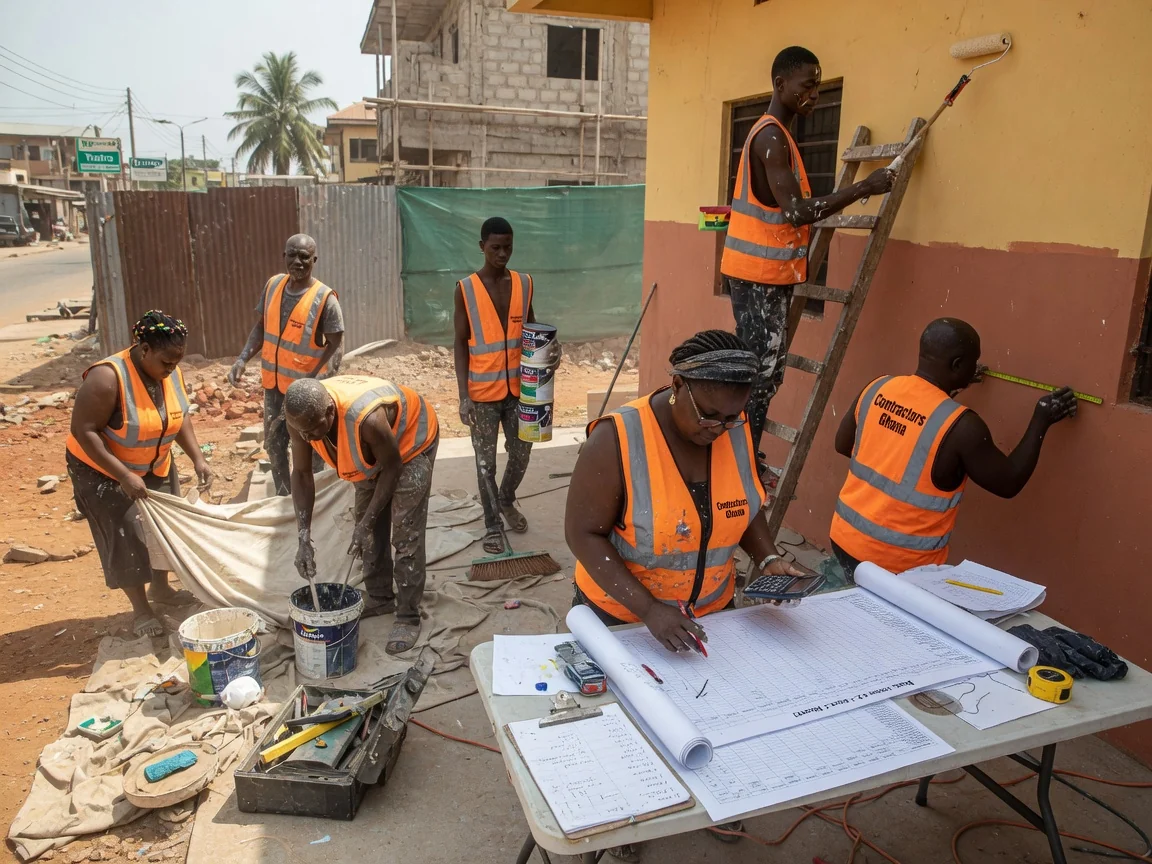
What Actually Drives the Cost
| Driver | Why it moves the cost |
|---|---|
| Design | Size, storeys, spans, and structural complexity set the quantities of concrete, steel, and blocks |
| Finish level | Basic, mid, or luxury — finishes can be 40–50% of the total; the same shell varies several times over |
| Site | Slope, access, and soil change earthworks, retaining, and substructure cost |
| Foundations | Weak or wet soil demands deeper or engineered foundations — a major early cost swing |
A BoQ captures all four for your specific project. A per-square-metre rate captures none of them — which is why it is not a real budget.
Material Prices — The Figures That Are Genuinely Published
Unit prices for materials are published and corroborated, so we quote them honestly. What they cannot give you is your total — that depends on how many of each your design needs, which is what a BoQ measures.
| Material | Genuinely published range | Note |
|---|---|---|
| Cement (50kg bag) | GH₵85–130 per bag | CIMAF at the lower end; Dangote / Ghacem Super Strong at the upper end |
| Iron / steel rods (per ton) | GH₵6,300–11,000 per ton | Varies by diameter (10mm lower, 20mm higher) |
| Concrete blocks (each) | GH₵4–10 each | Hollow / solid / interlocking |
A note on figures you may see online: some sites quote cement at GH₵185–240 a bag or rods at GH₵19,000–25,500 a ton. Those are roughly double the real, corroborated prices and are erroneous — do not budget against them. The ranges above are the ones that hold up across published price lists.
Why We Give You a BoQ, Not a Per-Square-Metre Guess
A measured BoQ does four things a per-square-metre rate cannot:
- It gives you a real budget for your specific design, site, and finish — not a content-marketing range.
- It shows you where the money goes, section by section, so you can make informed choices on finish and scope.
- It becomes the tool we procure against and measure progress against, so cost is controlled, not discovered late.
- It protects you from the number that doubles halfway through — the single most common way builds go wrong.
This is why every Contractors Ghana project starts with a quantity-surveyor BoQ. It is more honest, and it is the only figure you can actually build on.
Credentialed & Classified
- Costs prepared by a quantity surveyor (GhIS) — the profession that governs BoQ practice in Ghana
- Builds to Ghana’s building regulations (L.I. 1630) and the Ghana Building Code (GS 1207:2018)
- Registered professional input — architects (GIA), engineers (GhIE / Engineering Council) — on projects that require them
- Building-permit and EPA permitting (L.I. 1652) handled as part of the project
- Capability statement + contractor classification shared on request
- Established 1980 — a real firm with a portfolio, a written warranty, and accountability
Areas We Serve
Contractors Ghana prepares Bills of Quantities and builds across Greater Accra — East Legon, Airport Residential, Cantonments, Trasacco, Spintex, Tema, Adenta, Dzorwulu, Labone, Ridge — plus Kumasi and Takoradi. Diaspora clients in the UK, US, Canada, and Europe budget and build with us remotely.
Related Services
- Building Contractors in Accra — design, build & manage, end-to-end
- Design & Build — one team from concept to completion
- House Construction — new homes, fully managed
- Build From Abroad (Diaspora) — build in Ghana from anywhere
- Estimating & Procurement — BoQ-led costing and buying
- Quality Assurance Programs — stage checks to the Ghana Building Code
- Multi-Trade Orchestration — every trade managed under one team
- Decade-Warranty Execution — workmanship backed in writing
- Specialist Project Execution — complex and bespoke builds
- Renovation & Restoration — refurbishment and structural change
- Commercial Fit-Out — office, retail, and showroom fit-out
- Institutional Construction — schools, clinics, and public buildings
Frequently Asked Questions
How much does it cost to build a house in Ghana in 2026? There is no honest single per-square-metre or per-bedroom price — published estimates diverge three to five times over (roughly GH₵1,200 to GH₵6,500-plus per square metre) because every design, site, and finish is different. The only honest figure is a Bill of Quantities measured for your specific build, which we prepare so you budget against a real number.
Why will not you just tell me a price per square metre? Because an honest one does not exist — a basic two-bedroom shell and a luxury four-bedroom on a sloping site differ several times over per square metre. We give you a measured BoQ instead, so the figure is real.
What are the actual material prices in Ghana right now? Cement is roughly GH₵85–130 a bag, iron/steel rods roughly GH₵6,300–11,000 a ton, and concrete blocks roughly GH₵4–10 each. Higher figures sometimes seen online are erroneous. Unit prices are real; only a BoQ turns them into your total.
What drives the cost of a build the most? Design, finish level, site, and foundations — in roughly that order. A BoQ captures all four for your project; a per-square-metre rate captures none of them.